Price Action vs. Signal Action: The Distinction That Changes Everything
Price tells you what happened. Signal tells you what's likely to happen next. Confusing the two is the most common analytical error in crypto. Here's how InDecision separates them.
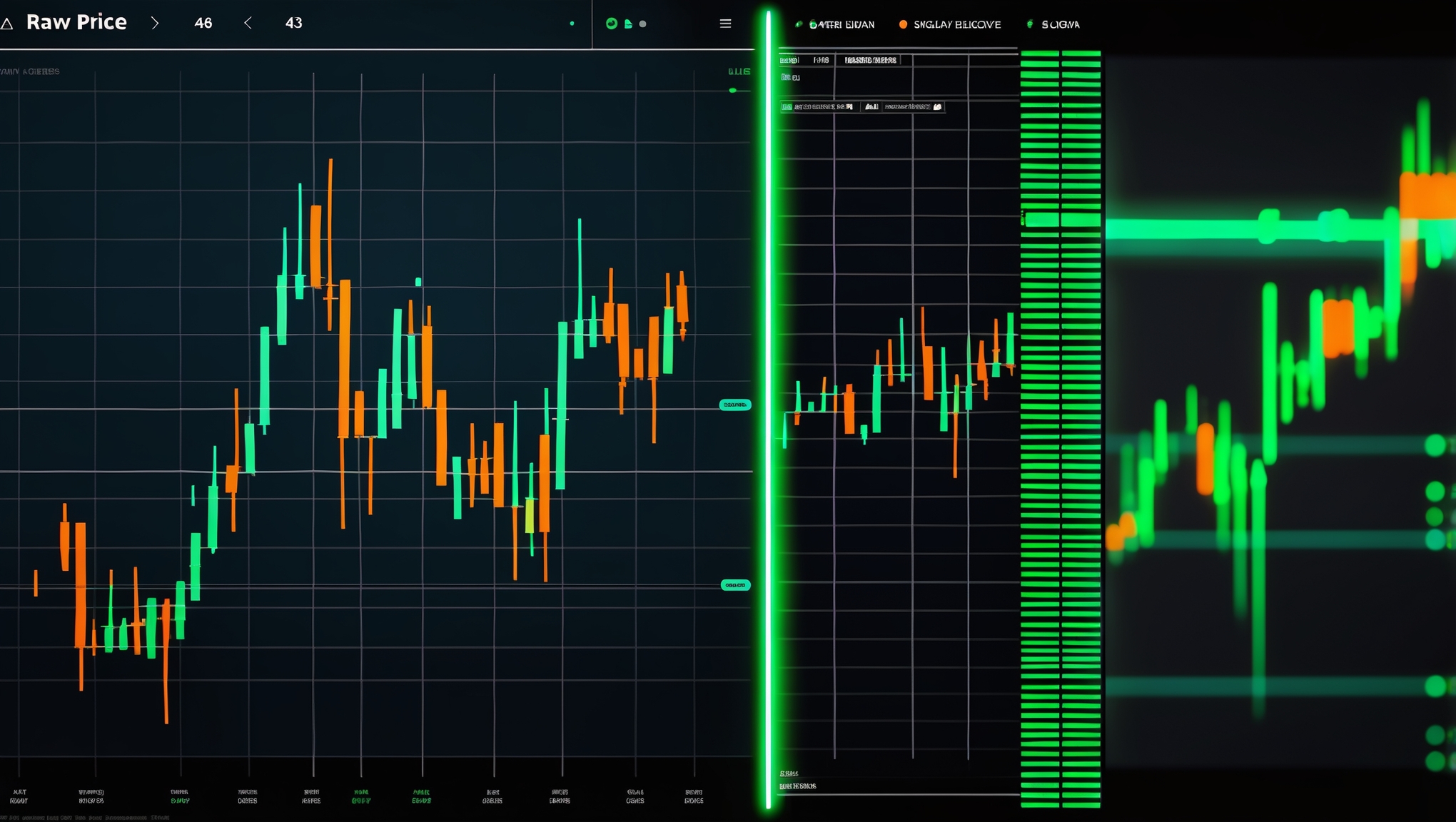
Price is history. Signal is the edge.
Every price movement you observe happened in the past. The candle that closed bullish is done — it's a record of what traders decided in that period. The price action you're analyzing is a historical document, not a prediction.
Signal is different. Signal is the leading information that tells you what pressures are building, what structural conditions are in place, and what the probabilistic next move looks like. Signal is forward-looking. Price is backward-looking.
Confusing these two is where most retail analysis goes wrong.
The Common Mistake
The most common form of this confusion is interpreting recent price action as predictive rather than descriptive.
"Bitcoin is up 8% this week, so it's likely to continue higher."
That sentence sounds analytical. It's actually just momentum extrapolation — assuming that what happened recently will continue to happen. This has no statistical validity in itself. The momentum might continue. Or it might be the top of a distribution move.
Recent price tells you where price has been and what the market thought in that window. It tells you nothing about what's next unless you combine it with signal data.
What Constitutes Signal
Signal is information that has predictive validity — that is, it has been shown to systematically precede certain market conditions.
In InDecision, signals include:
- Funding rate extremes — historically precede reversals when at extremes
- OI expansion patterns — distinguish new position building from short covering
- Session volume context — distinguishes real moves from low-liquidity manipulation
- Structural level reactions — price behavior at key levels reveals whether supply/demand is shifting
- Factor alignment — when multiple uncorrelated signals agree, the statistical case is stronger
None of these are certain. All of them have demonstrated forward-looking validity in backtesting. That's what makes them signals rather than descriptions.
Reading Price Action Correctly
Price action isn't useless — it's just frequently misread.
The correct use of price action is as evidence for or against the signal picture:
-
Confirmation: The signal suggested bullish conditions. Price broke above a key structural level with volume. The price action confirms the signal. Conviction increases.
-
Contradiction: The signal suggested bullish conditions. Price broke below support on high volume. The price action contradicts the signal. Investigate and potentially reassess.
-
Noise: The signal suggested bullish conditions. Price dipped 3% intraday and recovered. The price action is noise — it doesn't contradict the signal meaningfully.
Price action is the test of the signal. When they align, act. When they contradict, reassess. When price wiggles within the signal's expected range, ignore it.
How InDecision Processes Both Layers
InDecision receives price action data as input to its factors but outputs signal-based assessments:
The daily pattern factor processes historical price patterns and current price position relative to structure. This is price action in service of signal — using what happened to identify where we are in a repeating pattern.
The technical confluence factor processes current price action at key levels. Again, price action as evidence of signal — are the relevant structural levels holding or breaking?
The framework never says "price went up 5%, so InDecision is bullish." It says "given the current state of all six factors, the market has these characteristics, which historically precede these outcomes, at this confidence level."
The Forward-Looking Frame
Every piece of analysis should be answering one question: "What is the probabilistic next move given current conditions?"
Price answers: "Where did the market come from?" Signal answers: "Where is it likely to go?"
InDecision is built to answer the second question. The price data goes in. The factor assessment comes out. The output is a forward-looking probability distribution — not a certainty, but a systematically constructed view of what's likely.
Trade the signal. Use price to confirm it. Never confuse the two.
Explore the Invictus Labs Ecosystem
// FOLLOW THE SIGNAL
Follow the Signal
Stay ahead. Daily crypto intelligence, strategy breakdowns, and market analysis.
Get InDecision Framework Signals Weekly
Every week: market bias readings, conviction scores, and the factor breakdown behind each call.