Position Sizing for High-Conviction Crypto Trades — The InDecision Model
Position sizing is where most traders leak. They size by emotion — too large when excited, too small when scared. InDecision makes sizing a mathematical output of conviction, not a feeling.
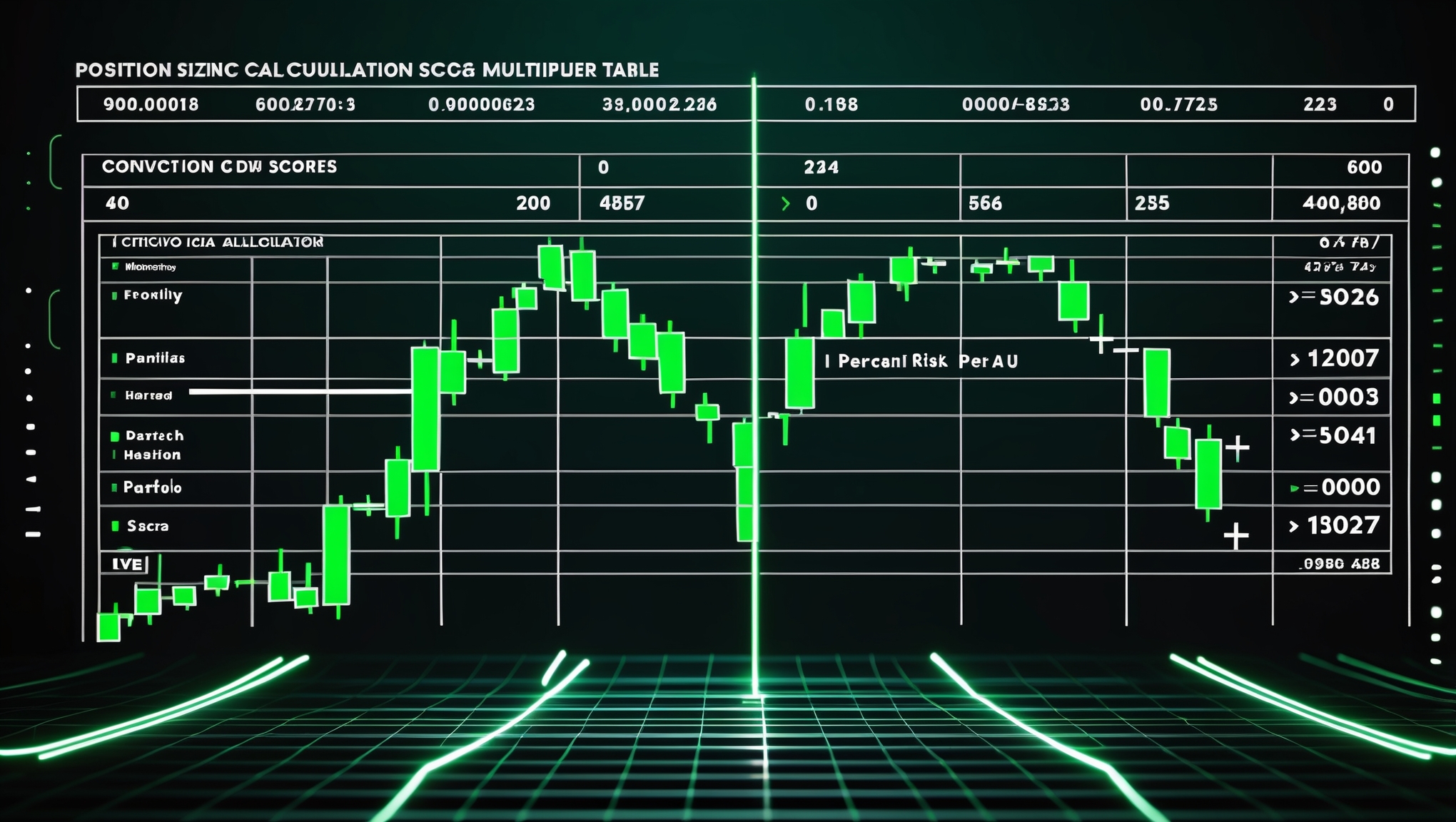
The most common trading mistake isn't a bad entry. It's the wrong size.
You can have the right direction, the right entry, the right target — and still blow out your account if you're too big on a losing trade and too small on a winning one.
InDecision solves this with a systematic size model tied directly to conviction scores. The emotion is removed from the sizing decision. The math takes over.
The Foundation: Risk Per Trade
Before conviction scores adjust size, you need a fixed risk-per-trade baseline. InDecision uses 1% of total portfolio equity as the base risk allocation.
This is what you're willing to lose on any single trade, before leverage or conviction adjustments. A $100,000 portfolio has a $1,000 base risk allocation per trade.
This number is non-negotiable regardless of conviction. Even a 95% conviction trade risks no more than the base allocation times the conviction multiplier. Never blow through the risk limits because you're "really confident."
The Conviction Multiplier
The conviction score scales the base risk:
| Conviction Score | Risk Multiplier | Portfolio Risk |
|---|---|---|
| 90-100% | 1.5x | 1.5% |
| 80-89% | 1.25x | 1.25% |
| 70-79% | 1.0x | 1.0% |
| 55-69% | 0.5x | 0.5% |
| 40-54% | 0.25x | 0.25% |
| Below 40 | 0x | ABSTAIN |
This structure ensures that when InDecision has maximum conviction, you have maximum exposure. When it has low conviction, you have minimum exposure. And when it signals ABSTAIN, you don't trade.
Converting Risk to Position Size
Knowing how much you're risking doesn't tell you how big to make the position. You need your stop-loss distance.
Position size formula:
Position Size = Risk Dollar Amount / Stop Distance
Example: You're risking $1,000 (1% of $100k portfolio) on a Bitcoin trade. Your entry is $95,000. Your stop is at $92,000 — a $3,000 distance.
Position size = $1,000 / $3,000 = 0.333 BTC
At 95% conviction with the 1.5x multiplier: $1,500 / $3,000 = 0.5 BTC
This is how position sizing works in InDecision. The conviction score and the stop distance combine to determine how many units you hold — not your gut feeling about how much you want to own.
Scaling In vs. Full Position
InDecision allows for scale-in strategies when conviction is in the 55-69% range.
The scale-in approach:
- Initial position at 25% of full size when conviction is 55-65%
- Add to 50% when an intraday confirmation signals increase conviction
- Add to full size when conviction exceeds 70% with intraday confirmation
This approach is more complex than a single entry but allows InDecision to participate in setups that are developing rather than waiting for the entire setup to be perfect.
The risk on the initial position is always capped at 0.25% of portfolio, with the add-on entries increasing risk as conviction increases. Total risk never exceeds 1% until the position is fully convicted.
Why This Math Changes Your Psychology
When sizing is mechanical and conviction-based, something happens to your psychology: trades stop feeling personal.
A trade at 72% conviction that goes against you is a $1,000 loss. At 1% of portfolio, it's noise. You exit cleanly, learn from the factor analysis, and look for the next setup.
A trade at 92% conviction that goes against you is a $1,500 loss. Still manageable. Still no catastrophe.
You can lose 10 maximum-conviction trades in a row and still have 85% of your capital intact. The math makes consistency possible.
Compare this to a trader who sizes by emotion: they get excited, go 10% of portfolio on one trade, it goes against them, and they're in a psychological hole that distorts all future decision-making.
The math isn't just how you size. It's how you maintain the equanimity to keep trading well.
Explore the Invictus Labs Ecosystem
// FOLLOW THE SIGNAL
Follow the Signal
Stay ahead. Daily crypto intelligence, strategy breakdowns, and market analysis.
Get InDecision Framework Signals Weekly
Every week: market bias readings, conviction scores, and the factor breakdown behind each call.